


Over winter break, some athletes spent time with their families, while others simply relaxed, but App State Cheerleading had something bigger in mind: a national championship. On Jan. 16, the Mountaineers traveled to the ESPN Wide World of Sports in Orlando, Florida to compete in nationals.
For the first time in App State history, the Mountaineers advanced to the finals after finishing second in the semifinals.
“If I can explain finals, it is a last opportunity. You work for a whole season, and you bust your butt, and you work your tail off. Day two is your last opportunity to show everybody what you can do. And the season’s over after that,” said senior co-ed base Tyler Musso.
While many aspects were essential to the team’s success, much of it was attributed to their strong sense of unity and intentionality. Being vocal with one another on and off the mat, calling each other out and spending every moment with one another were integral to their success.
At nationals the year prior, the team arrived with high expectations but was disappointed when it missed the cutoff. The difference was the unspoken agreement that solidarity was success; unity was key to making it to nationals.
“We really, as a team, came together. We all had a common goal, and we all had expectations,” said Musso.
That unity was not created overnight. Before athletes officially become members of the App State cheer team, Coach Morgan Delgado watches how athletes perform and act in performances. The coaching staff attends college cheer combines, an event where cheerleaders are able to showcase their abilities, to scout transfers and high school athletes for the upcoming year. If chosen, prospects are invited to clinics where they are fully assessed. This is done not only by evaluating skill, but also attitude, work ethic and personality.
In previous years, the coaching staff looked to recruit 20-25 incoming prospects.
This year, however, they focused on roughly 10, emphasizing quality over quantity. Delgado said incoming recruits may have envisioned themselves in a specific position, but she might recruit them for a different role instead. In co-ed cheer, one male and one female make up a stu
nt group, and all-girl groups consist of four females. The ability to adapt allows flexibility that has carried the team in the past, and it has finally paid off.
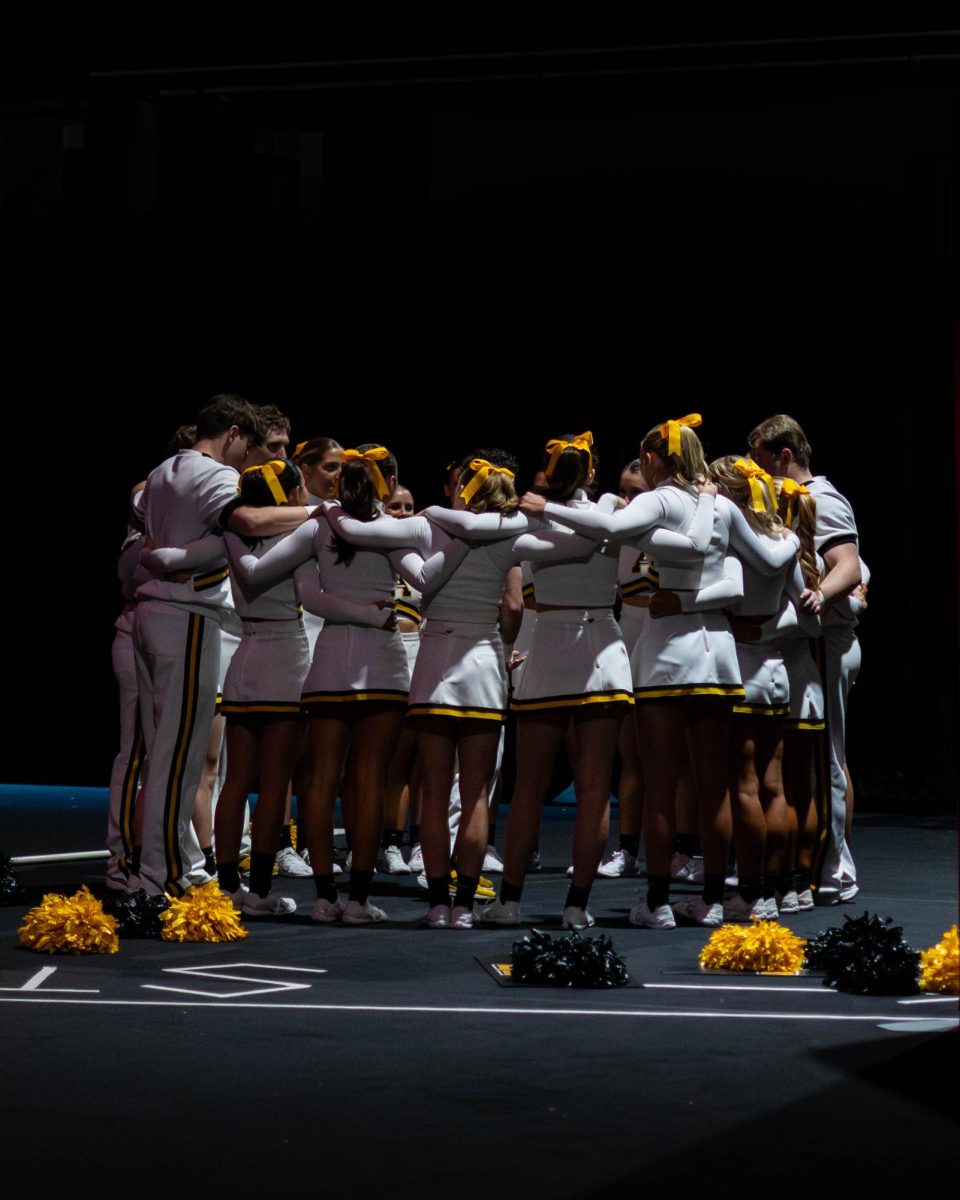
For the first time in program history, App State cheer made finals with a 90 raw score.
A raw score is calculated on a scale of 50, then multiplied by two. The score is based on a combination of technique, difficulty and execution that is judged throughout the performance.
Then, the number of mistakes and legalities is subtracted from the final score.
“We literally fly in the air,” Musso said. “I think that’s what people don’t understand.
They’ll look at cheer and think, ‘Oh, pompoms and stuff like that.’ No, we, like, fly. We throw people; we throw our own bodies.”
Advancing to the finals is the highest stage a team can reach, a moment Musso called “basically every cheerleader’s dream.” Only the top teams from the semifinals earn that final performance where everything comes down to one routine. With the competitive season ending immediately after, the pressure is intense, and the opportunity is rare.
Reaching that milestone also shifted the perception of the program from goal to reality. The athletes prove that their preparation could withstand the pressure of a national stage.

“This year we had a goal, but we truly believed that we could achieve it,” senior co-ed tuck-top girl Katie Kilduff said.
Each moment on the mat showed the countless hours of work put in by the team.
The season became a reflection of how far the program has come, and a shared commitment to improvement in future seasons.
Delgado said recruitment includes attending cheer combines and hosting on-campus clinings where athletes are evaluated not only on skill, but attitude and teamwork.
“We’re not just looking at how they are athletically, but how they are personally,” Delgado said. “We’re huge on our team culture.”
All athletes complete the program’s tryout and placement process, where coaches evaluate consistency and commitment to the team. Even recruited athletes must complete the formal tryout and team placement process. With a roster of more than 40 athletes but only 20 competition spots available, Delgado said mentality and teamwork make the team as much as technical ability.
“The goal is to make the team the best,” Delgado said. “If the team succeeds, the whole program succeeds.”