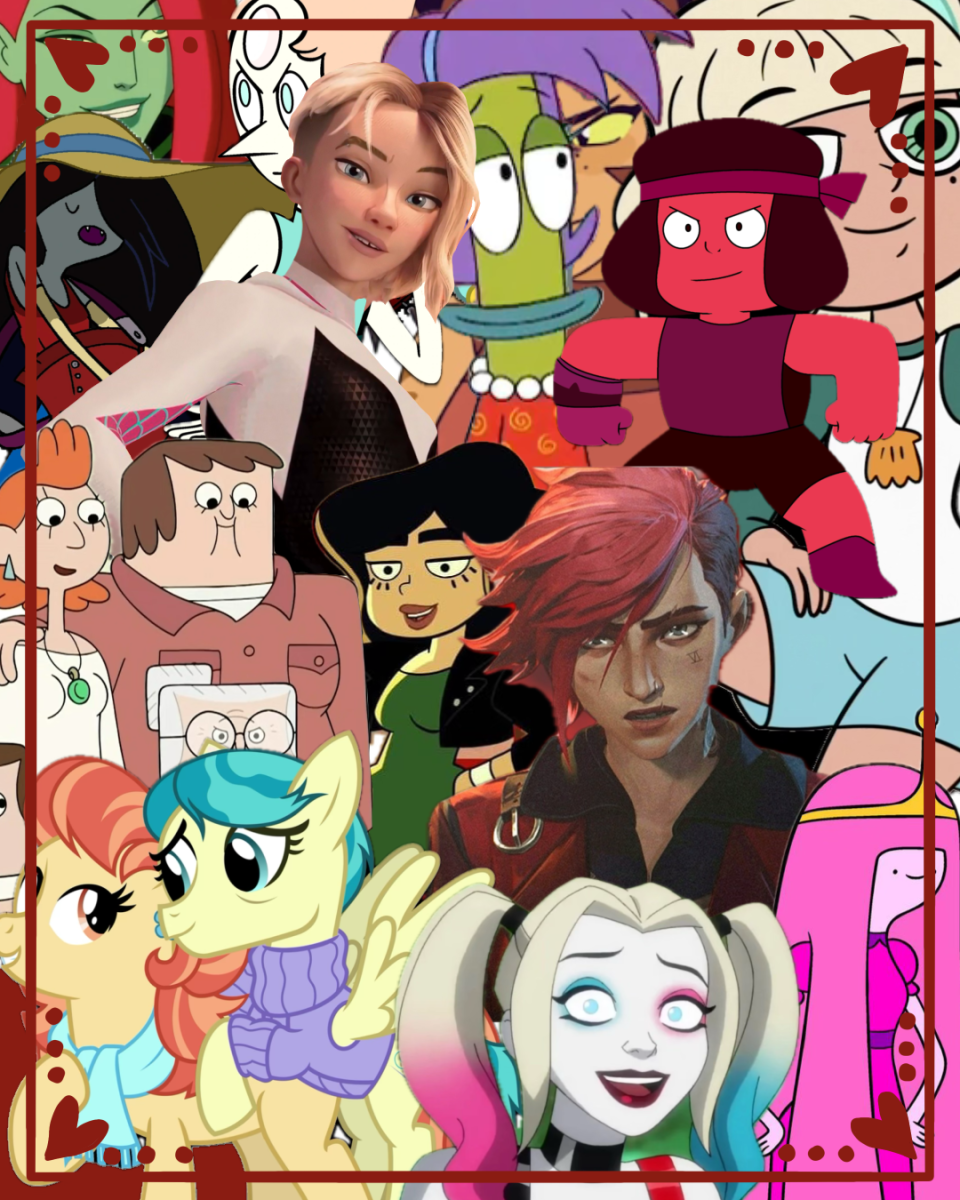
The 2023 film “Spider-Man: Across the Spider-Verse” and “Arcane,” a show that first aired in 2021, are among the most critically acclaimed animated works of the last few years. Both are adapted from male-dominated areas of interest, with “Across the Spider-Verse” adapted from the Marvel Comics and “Arcane” adapted from the video game League of Legends.
The superhero genre, as well as video game culture, have their fair share of controversy surrounding their portrayal of women and female characters, ranging from a lack of female main characters to the misrepresentation of women. Gwen in “Across the Spider-Verse” and Vi in “Arcane” challenge this narrative of women being underrepresented in male-dominated culture by serving as main characters who don’t exist to simply fuel the male characters’ stories.
Video game culture is often known to appeal to the “male gaze” due to its audience mainly consisting of heterosexual men. League of Legends specifically received backlash for designing their female characters in a way that appeals to the male fantasy. “Arcane,” however, refrains from this unrealistic perception of women, prioritizing their female characters’ personalities and purpose in the story over their appearance.
In the superhero genre, female characters are traditionally side characters meant to be plot devices in the male main character’s story. However, Gwen Stacy and Miles Morales serve as equal protagonists throughout the franchise. Rather than solely being a love interest for Miles, Gwen has her own identity and struggles throughout the film.
Both adaptations overlap queerness and transness into the identity of their female characters, placing women at the forefront of traditionally male-centered and heteronormative spaces.
Not only is it refreshing to see female characters who aren’t reduced to their appearance, it is profoundly inspiring. Women having control over their identities and the way that they present themselves to the world is something that should’ve been in the core of cinema from the beginning.
Vi and Gwen are main protagonists in their respective works, exhibiting leadership qualities and ultimately playing the role of a hero. Not only are both characters at the center of their stories, but they are not treated any differently from their male counterparts. Gwen serves as a mentor in teaching Miles about being Spider-Man and adjusting to his new identity. Vi, along with other female characters in “Arcane,” is arguably stronger and more assertive than many of the male characters.
Gwen proves that girls can be superheroes too: strong, powerful and an inspiration to others. Gwen in the live action films is Spider-Man’s love interest, she is ultimately saved by Spider-Man, whereas Gwen in the animated movies is not reduced to a damsel in distress. Instead of being saved by Spider-Man, she is Spider-Gwen. She does the saving.
Both characters explore differing spectrums of gender expression, refraining from the narrative that queer people must look or act a certain way. While Vi is overtly masculine presenting, Gwen exhibits a balance of masculinity and femininity, appearing more androgynous. She has short hair, which is typically considered masculine, but wears ballet flats in “Into the Spider-Verse,” a more feminine option. Gwen’s character design shows that women can embrace femininity and still assert dominance.
The relationship between queerness and gender expression is apparent in both Gwen and Vi’s development. Gwen is widely regarded as a trans-coded character within the Spider-Man fandom, and Vi is explicitly sapphic, having a queer-driven plotline, both of which contribute to an authentic and accurate representation of queer women in media.
The discourse surrounding Gwen’s transness lies between online speculation of her being an ally or being transgender herself. Transgender can refer to gender fluid or non-binary identities, which are showcased in Gwen’s ability to stylistically explore both femininity and masculinity.
One reason why some fans headcanon Gwen as trans is due to a scene with her father towards the end of “Across the Spider-Verse,” where she reveals her true identity as Spider-Man. This heartfelt interaction is often seen as an allegory for coming out. Furthermore, Gwen has a flag in her bedroom that reads “protect trans kids” and her father has a badge of the transgender flag on his uniform.
Another reason why Gwen might represent the transgender community is because she’s often draped in the colors of the transgender flag — blue, pink and white — especially during vulnerable moments.
While Gwen does not explicitly identify as transgender or cisgender, many in the LGBTQ+ community feel represented by her. Some fans might prefer to have overt representation in media, but there is something to be said about queer subtext. It’s important to note that representation can be subtle; not everyone is loud about or comfortable in their identity.
The discourse surrounding Gwen being trans-coded broadens the idea of what being transgender can look like. When a character’s identity is open to interpretation or not clearly stated, this allows more people to identify with that character. If someone feels seen by a character whose identity may not be intentional, that doesn’t negate the authenticity of portrayals of queerness.
While Vi’s sexuality isn’t explicitly labeled in the show, the creators have confirmed that she is queer. Vi’s sexuality isn’t all encompassing; it’s a huge part of her story, but it isn’t the only characteristic that defines her. Much of her storyline focuses on her love interest, Caitlyn, and how their relationship could negatively affect her existing relationships and understanding of the world — not because they’re in a queer relationship but due to their difference in social class and the ongoing conflict between their cities.
When it comes to sapphic representation, there tends to be an emphasis on tragic love stories. While the story of “Arcane” itself is tragic, Vi and Caitlyn have a satisfying ending. Their relationship is monumental in terms of sapphic representation in media, deviating from the typical stereotypes of romantic relationships between women.
“Arcane” also rejects the fetishization of queer women. Through the lens of the male gaze, both women would be feminine presenting because society assumes men are only attracted to feminine women. Sapphic relationships are also more digestible for people outside of the LGTBQ+ community if both women uphold traditional ideas of gender expression.
Vi presenting herself in a masculine way is inherently queer. Society prioritizes and upholds the gender binary by placing women in the feminine category and men in the masculine category. However, this is a very heteronormative way of approaching gender, and Vi represents masculine women in media who are often overlooked.
Normalizing existence outside of the gender binary and societal expectations of women creates a safe space for queer youth, women and girls to explore their identity and live freely. The attention to character design and character portrayal within these publications ultimately broadens the idea of what it means to be a woman, how a woman should look and how a woman should act. Putting strong and confident queer women at the forefront of cinema through characters such as Gwen and Vi creates a space that celebrates queer women’s existence and everything they have to offer the world.