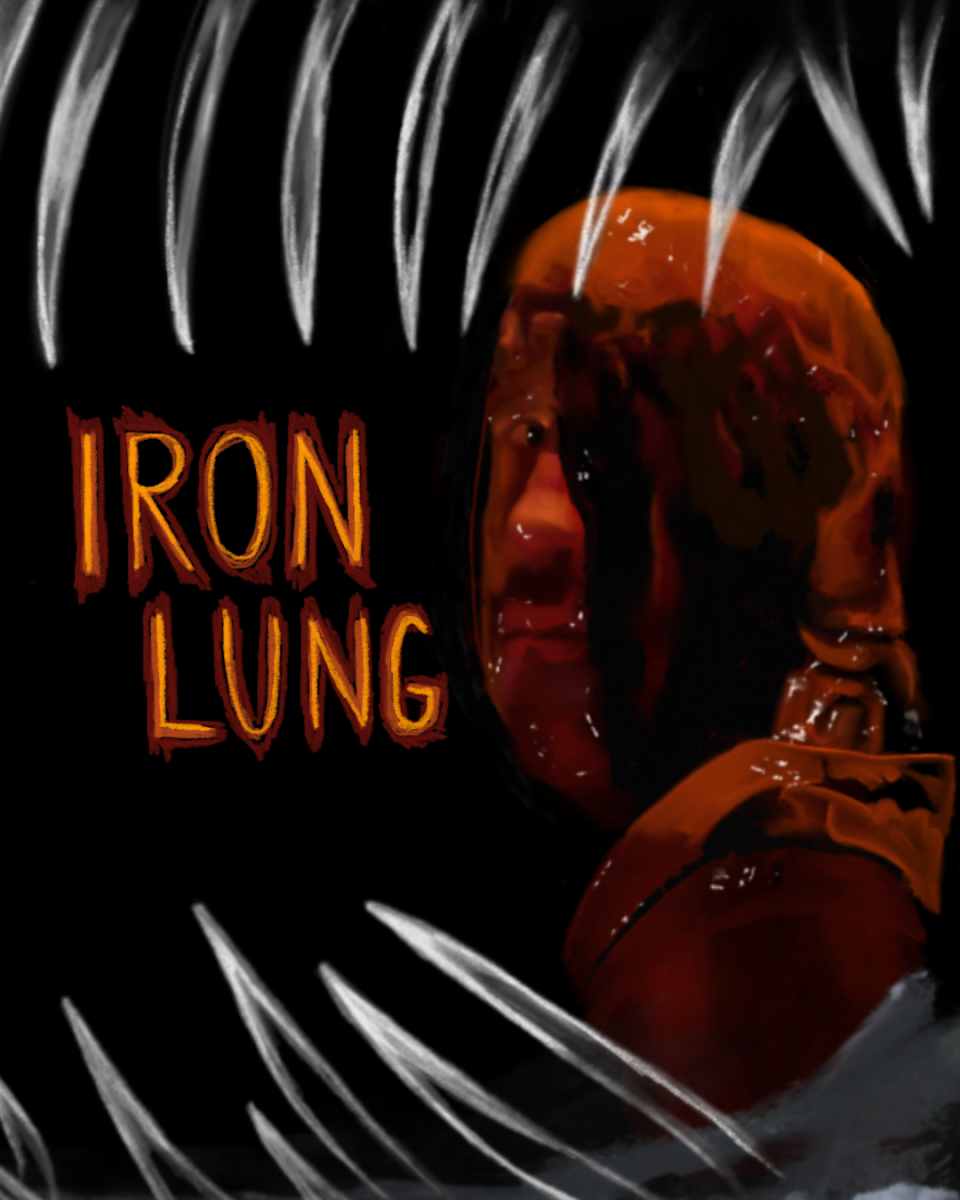
Editor’s note: This story contains spoilers for “Iron Lung” and graphic descriptions of gore.
Background of “Iron Lung”
Iron Lung,” a popular release for January, is one of the latest highly anticipated horror films to reach in 2026. Directed by Mark Fischbach, better known by his YouTube alias Markiplier, is over $50 million in gross worldwide revenue.
Since its release date on January 30, “Iron Lung” hasn’t stopped kicking around in the back of my mind.
As a psychologically immersive film, it preys on natural human instincts. The fear of the unknown; of what hides in the dark, just outside of your sight, as well as claustrophobia and a typical staple for horror films — extreme gore.
“Iron Lung” follows the mentally tortured main character Simon, more commonly referred to as “Convict,” a prisoner being sent into the depths of a bloody ocean as punishment for his crimes. Simon contributed to the destruction of his home, Filament Station, and the mass murder of its inhabitants.
The two-hour long film explores the more obvious themes of trauma, survivor’s guilt and the desperate urge to survive in the face of adversity. While Simon meets an untimely end, his death signifies the continuance of human hope and the future of society following the bleak result of “The Quiet Rapture” — a mass extinction event resulting in the vanishing of all stars and planets, leaving the surviving humans stranded on moons and space stations.
The themes explored in “Iron Lung” are captivating, providing a deep story on the strength of the human spirit and the mind-altering effects of grief and loss. However, these minor themes contribute to a larger and far more complex narrative than what is initially presented.
“Iron Lung” as a Commentary on Modern Christianity
“Iron Lung” begins with a retelling of an event of mass cosmic destruction, “The Quiet Rapture.” “The Quiet Rapture” forged a new coalition in the wake of the extinction of habitable planets, the “Consolidation of Iron,” an organization aimed at promoting unity, togetherness and protection against foreign threats, such as Eden.
Eden, a space station and home to Simon, attacked Filament Station and resulted in its destruction and the death of its inhabitants.
Following the destruction of Filament Station, Simon was captured by the COI and forced to atone for his crimes by descending into the blood ocean on a submarine dubbed the “Iron Lung.”
While exploring the ocean, Simon came across a creature in the depths, one that begins to follow the submarine around, seemingly taunting Simon in a disembodied voice.
The mention of raptures and atonement, along with a creature crafted in a godlike fashion, bloody baptismal imagery and subtle conversations about faith and atheism, “Iron Lung” creates an intense dichotomy between religion and trauma, one that asserts guilt and grief will not purify you, even if you immerse yourself in it. You’ll still have to live with it.
The Effects of Capitalism and United States Work Culture
Throughout Simon’s journey in the blood ocean, he is consistently told that his efforts are for a cause greater than his life, one even bigger than the lives of all the members of the COI.
Despite his protests and pleas to return to the surface, or even be placed back in a jail cell, he continues to follow every order he’s given for the slim chance at survival.
It’s a timeless tale that easily reflects the modern state of U.S. capitalism, with every working member of the system being treated as less than — mere cogs in the machine of broader operations.
Simon’s suffering is a direct contribution to the system created by the COI, yet he remains a pawn in the ever-continuing cycle up until the moment he dies. In a last-ditch attempt to survive, he maintains his efforts exploring and collecting data while operating under the assumption that he would be able to return to the surface.
However, despite his devotion to COI’s cause and his own presumed survivability, he gives his life in the pursuit of knowledge by saving the submarine’s black box, which contains crucial data about his findings while searching the ocean floor.
In the end, the “Iron Lung” implodes after being pierced by the monster’s teeth, filling with acidic oceanic blood and slowly deteriorating Simon’s body, splicing his flesh into the submarine’s metallic siding.
Individuality vs. Survival of the Whole: The Blood Ocean as a Parasite
The deterioration of Simon’s flesh due to the acidic blood and its combination with the “Iron Lung” is similar to that of a symbiotic relationship, with Simon’s sacrifice reforming into the submarine and potentially the monster itself.
With the submarine and monster’s connection to the broader goal established by the COI — to find a way to advance society and find solutions to survival in the wake of “The Quiet Rapture’s” aftermath — Simon’s death leads him to become a physical part of the system he sought to find a place in.
He survived and became a part of the larger cause, but at the cost of his life; much like the death of a host after a parasite has drained it of all it can hold. Once Simon’s usefulness to the COI was used up, he became absorbed into the exploitative system that had absorbed all of his humanity.
Final Thoughts
“Iron Lung” is a film that can be easily adapted to represent the larger human experience. Its commentary on grief tells a story of hopelessness — of a lack of strength to continue on when so much has been taken from you, generating simultaneous feelings of loss and a desperation to keep living, just to prove things aren’t so bleak.
But it can also be tied to religion, or a critique of capitalist society or maybe the prison system itself, which is really just a subset of the capitalistic tendencies our society tends to hold close.
I think most of all, “Iron Lung” is a deeply emotional story that encapsulates at least one thing about every single person who sat in the audience and watched it on the big screen. What connects us the most to one another is the fact that we all have experienced the same hardships at one time or another.
Grief and sadness and loss, or the painful need to survive in the face of adversity, or maybe just the desire to prove something to the exhausting society we live in — that we can stumble or make mistakes and still come out on the other side providing more to life than we ever thought we could. That there’s a guiding, peaceful light at the end of all of our hardship that leads us to exactly where we were meant to be.