


Painted in plaid and curated with care, Andréa Keys Connell’s “Pattern Mapping” is a treasury of artistic vision bridging the gap between grief and hope.
The exhibit was unveiled on June 28 in the Rankin West Gallery of the Blowing Rock Art and History Museum, and will be on display until Nov. 29.
Patterns have served as an influence in Connell’s work since her years in graduate school. Although this influence has been both literal and metaphorical, it took on a new medium three years ago when she decided to add plaid to multiple sculptures.
“Plaid itself is one of the most universal patterns in existence — and textiles — and it’s been found on every continent in the world,” Connell said. “It is often used to symbolize, or to cloak, or to warm the bodies of families.”
Surrounded by plaid sculptures, Connell described the connection between sheep and plaid as something so specific, she had to put it everywhere.
“It’s comforting, it’s protective, it’s warm, it’s of the home, it’s of the body, it’s also oftentimes made from wool, which is of the sheep,” Connell said.
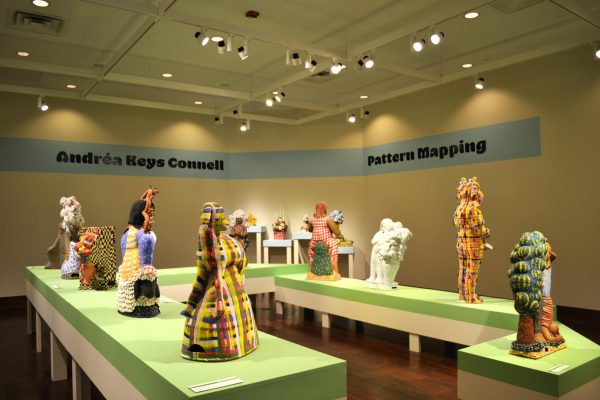
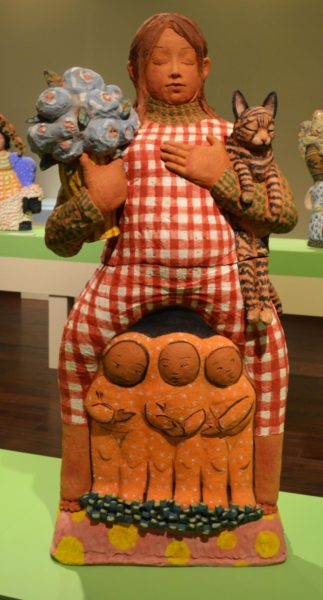
Fostering the idea of care through the depiction of sheep, she related it to the connection between a mother and child. Works from her collection “Mom” are featured in the exhibit, notably “Mom Chair,” which presents a child sitting in their mother’s lap, while the mother appears somewhat camouflaged in a plaid pattern.
“I kind of think of them as ways of marking my experience of time in various ways, specifically as a mother,” Connell said. “It’s like, in the best caring moments, you’re there to prop another person. It’s not about you, right?”
This central theme of motherhood within her sculptures begins with the clay body itself. She presented it as a reflection of the human body, but more specifically, “a mom clay body.”
“It’s very gritty and strong and resilient and can withstand great temperature and pressure and all of those things,” Connell said.
The custom clay body she uses combines sand, grog and fibers, designed to allow for impulsive and quick molding. Connell said this adjustable nature highlights the imprints clay holds from its creator, marking each stage of her works with a personal touch.
“I’m leaving more and more of my own marks behind, and recognizing the pattern in those moments too,” Connell said. “And to me, that’s such a poetic thing when you’re talking about memory, care and time, and all of those things that can refer back to an imprint.”
Alejandra Gaytan, a senior studio art major and student under Connell, wrote in an email that intentional focus and patience with clay help them process personal experiences.
“Clay has a way of teaching the creator and allowing one to process their worldview,” Gaytan wrote. “After firing and glazing, it feels like those emotions have moved through me and I can move on.”
In 2021, Connell lost the majority of her artwork to a fire. In the aftermath of this devastation, she reassessed two central themes within her art: cycles and motherhood. Similar to her fascination with patterns, Connell immersed herself in these themes to aid her acceptance of the pieces she had lost.
“They were all pieces that pointed to really specific things with my family,” Connell said. “They talked about love and connection in a way that was deeply personal, but like a personal that I think is so universal.”
One piece resembled a mother balancing a baby on her head while holding a sheep. Connell said she couldn’t let go of this piece in particular, leading her to reimagine it in a piece titled “Holding,” which is present in the exhibit.
This experience prompted Connell to reflect on the archetypes she had been told to avoid in her formative years.
“When I was a graduate student, I was taught that making work about being a mom was an incredibly cliche thing to do,” Connell said.
She posed the question of how something so universal through human connection could become cliche. “If art is about connection, then how can that not be on the menu of conversation with art from a woman’s perspective?” Connell said.
Through the acceptance of loss, Connell was able to regain a sense of control over her craft, disregarding the “rules” while also negating what audiences thought of her work. As an associate professor of ceramics, this is something she tries to instill in her students.
Connell believes it is not about her personal taste when guiding or evaluating her students’ art, but rather encouraging them to trust their own unique voice.
Gaytan credits Connell’s hands-off approach to helping them develop a personal artistic aesthetic.
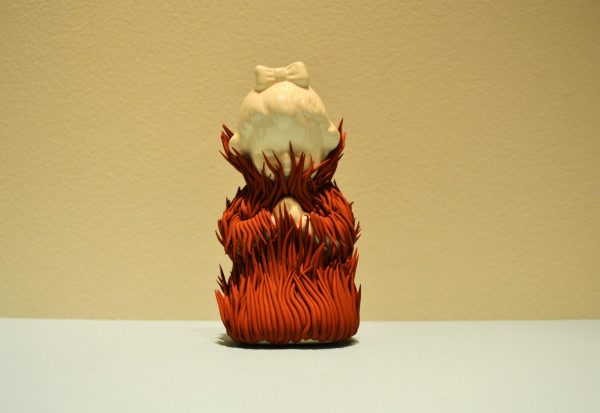
“It encourages me to explore my individual voice rather than replicate hers, which has strengthened my confidence in my creative decisions,” Gaytan said. “Andrea makes figurative sculptures and animals. I choose to sculpt a giant toothbrush.”
Connell applies these perspectives of open-mindedness and individualism to the audiences she reaches beyond the classroom as well, insisting on a space of interpretation for viewers.
“Those spaces of ambiguity, I think, allow a person to create their own story,” Connell said. “I definitely don’t own the stories and the work that I’m making, and I would never want to tell somebody what they’re supposed to see, feel or think from the work.”
Curating patterns of love, loss, connection and care, Connell creates multiple vessels of reflection for viewers through ceramic figures painted in plaid.
“I guess if anything, I hope that when people see somebody expressing an intention towards care, they feel cared for themselves,” Connell said.