Students around App State’s campus can be found donning vintage clothing from decades before their time, with certain articles being specially crafted to have an extended lifespan. Decades from now, our presently-made clothes will be found in a landfill.
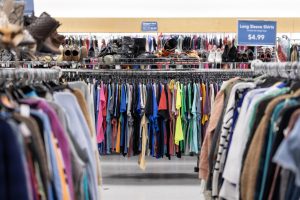
Fast fashion is the rapid manufacturing of clothing to match current trends in an ever-changing market. Debra Harmon, the shop manager for Ram’s Rack Thrift Shop, said she sees a plethora of fast fashion being donated to them.
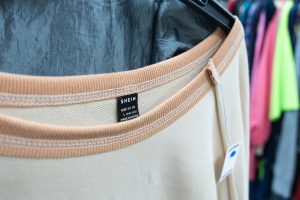
“We do see quite a bit of the fast fashion in here. You get the Shein brands and, you know, the disposable clothes,” Harmon said. “They’re not meant to last.”
Harmon said the store’s most popular items are always the vintage pieces, as they are higher quality choices over most modern clothing brands.
“Something that’s been around since the ‘70s is very sustainable, so everybody gets more excited over that donation,” Harmon said.
Lanie Karstrom, the sustainability outreach director at App State, said the waste that fast fashion manufacturing practices produce is extremely unsustainable.
“We have so much stuff; we don’t know what to do with it,” Karstrom said. “It’s piling up in our landfills, it’s piling up on the sides of the roads, it’s piling up in people’s homes, and we don’t know what to do with it.”
The director of Ram’s Rack, Kelly Barefoot, said all of their unsellable donations are packaged and redistributed to Value Clothing, Inc. — a recycling company. This allows the items to be repurposed and prevents them from ending up in a landfill.
Barefoot said the fibers from shirts can be recycled for medical use, and Harmon said the bottoms of tennis shoes can be ground up and used to make asphalt.
Simple recycling practices being put in place for companies like these are an effective way to address overconsumption and the fast fashion industry — even when it feels like an overwhelming issue.
“You just kind of have this uncontrollable, fast-growing, easily accessible process that is creating these environmental and social externalities that are not being accounted for,” Karstrom said.
Karstrom said fast fashion expanding so rapidly is a symptom of a larger issue: consumerism.
“There are lots and lots of areas where consumerism is the problem, and that really stems back to the capitalist boundaries and whether or not we have them,” Karstrom said. “If you’re always raising the bar, it’s going to require more and more resources.”
Fast fashion is an issue that runs deeper than most people think, Karstrom said, as most of the environmental damage is not seen immediately by consumers.
Countries like Ghana and Chile are ultimately forced to receive the United States’ textile waste when recycling companies take discarded clothing from various producers. Though consumers are often under the impression that the clothing will be repurposed and recycled responsibly, this is often not the case.
According to the Boston University School of Public Health, 66% of unsellable clothes are landfilled, while 19% are burned. Those who live in countries with textile landfills or open-air dumps must directly face the aftermath of fast fashion with severely contaminated water, soil and air, as well as microplastic pollution.
“We don’t have to see the consequences, right?” Karstrom said.

Megan Prosser, a senior sustainable development major, emphasized the importance of mending your own clothing to combat the unsustainable effects of fast fashion.
“Learning how to mend clothing is a really awesome skill that a lot of people don’t have,” Prosser said. “I think the last time I used a sewing machine was probably in, like, home ec in middle school.”
Prosser said university resources like the Makerspace are great ways to learn skills such as sewing, upcycling and mending to repurpose clothing you would typically throw out.
“The Makerspace can really flush out some student employee positions that are turning out workshops and engaging students on different ideas around extending, you know, the life of the things that they own,” Karstrom said.
Another on-campus resource is the Free Store in the Office of Sustainability, located in the lower level of East Hall, which provides students with an eclectic array of clothing items at no cost in the hopes of promoting textile conservation.
Karstrom said the free store constantly receives a plethora of fabric that students can use to adapt or create their own items as well.
“Sustainability is a journey, right?” Karstrom said. “We’re always growing; you just gotta start.”