Boone has a deep history with music and with bands such as Rainbow Kitten Surprise and The Nude Party sprouting from the area, the college town is known for its encouraging local band scene. However, what is often overlooked when discussing local band culture is the function of a house show.
House shows differ from a typical party, serving as an unofficial music venue where local bands can perform. Often taking place in either someone’s basement, backyard or front porch, these shows provide a space for college students to unwind and for bands to gain performance experience.
“It’s a different scene from people who constant the bars or Greek life. It’s a different group of people looking for something to do and to come together and to watch some local music,” said Jack Thornton, an App State graduate and one of the founders of BrikHouse.
BrikHouse was started around three years ago and not only hosts events at their house but also sponsors events at other venues, such as Betsy’s Barn or the Zionville Ramp Co. They focus on bringing local bands to their venues to allow for people aged 18 and above to enjoy live music.
“I think that 18 plus spaces are very important to the music scene because most people in college — at least half — are under 21. And if you make music inaccessible to them, they will start to not care, and when they turn 21, they will still not care,” Thornton said.
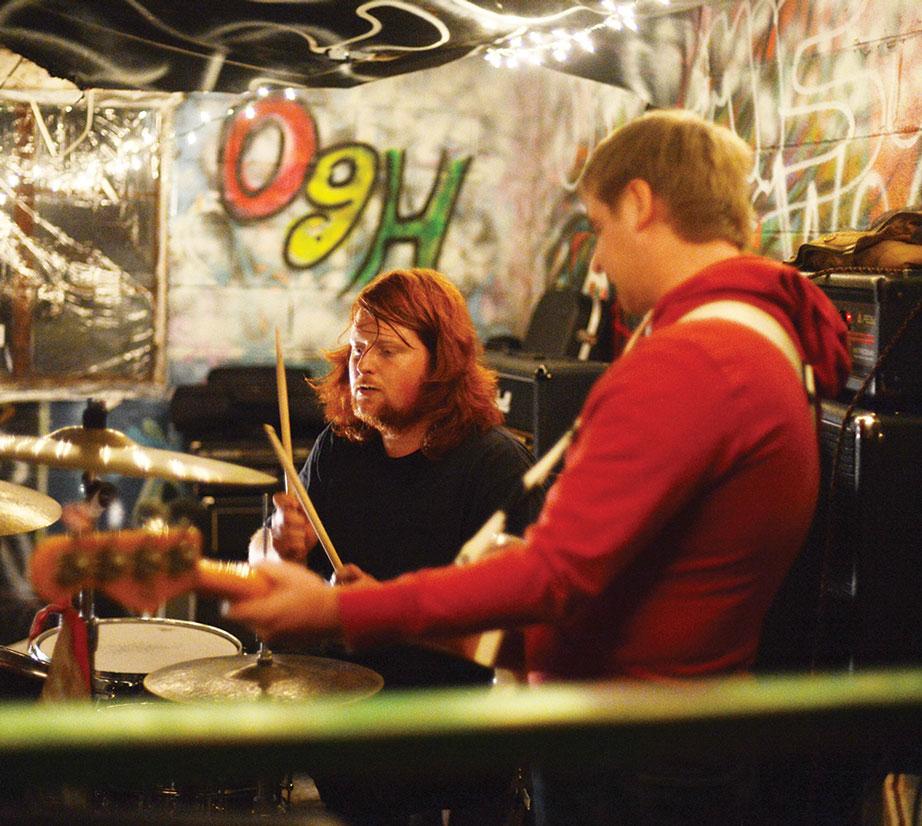
With a stage in one corner and a spray-painted wall surrounding dancers and musicians alike, the organization first started out with a small team in a basement. In recent months, as their venue has gained more traction, they’ve had to look toward other locations to increase the capacity for their shows.
This shift is partly due to safety reasons, as a higher capacity of attendees creates greater liability for the hosts.
“Our goal is to provide a safe space for people who maybe can’t go to a show at a bar and to provide maybe even a first experience with live music,” said Pixie Hocker, who joined the BrikHouse team a year ago.
The house show culture in Boone has traditionally been a more underground scene where word of different events spread through flyers, word of mouth or, in more recent years, social media.
Carly Martin, a junior double major in business management and general marketing, started an Instagram account three years ago as a resource for people to find local events in Boone.
“There wasn’t really a resource to go to where you could find all the events happening in one place,” Martin Said. “Being a freshman, I found it difficult to find stuff to go to, so I took the initiative to be that person and be that resource.”
Martin’s account, known as Chatterbox Boone, advertises a variety of local events, including house and bar shows, vintage markets and other local events. The account’s main focus is to reshare flyers and event information Martin gets sent to her social media.
The shift away from traditional house shows has been evident on her feed, with fewer posts promoting intimate shows and more featuring big parties hosted by established venues, according to her account.
“I mainly think that’s because a lot of the landlords in this town have gotten very strict about what you can do at these houses, as well as the police; they shut down things as early as they can, and then the owners of the houses get in trouble,” Martin said. “So it’s mostly just people not wanting to run the risk of legal trouble or getting evicted.”
Eviction poses a real threat to some of these venues due to noise ordinance violations and conflicts with landlords. Organizations like ChopHouse have lost their venue due to these conflicts.
Spencer Armstrong, a senior sustainable development major, is one of the founders of ChopHouse, which has been a prominent show organizer since 2023. The venue originally started because of a birthday party celebration for another one of the founders, which turned from a 60-person event into a 300-person party.
“We realized if we charge people at the door, we could probably pay our rent this way and also provide something for the community,” Armstrong said.
Unlike some of the older house venues, which have a singular location for each show, ChopHouse is an official business that hosts local bands. They collaborate with other venues, such as the TApp Room, for a location while they focus on the production and marketing.
“I feel like, recently, it’s been really hard for anybody to kind of get a foothold in Boone,” Armstrong said.
Although the culture of house shows in Boone is shifting towards more commercialized venues for safety and production reasons, the bands that play at each show are having to work harder in order to get their music heard.
“You are providing a spot for local bands to perform at, and they are performing for you. It’s definitely a mutual relationship,” Armstrong said.
One group prominent in the local scene is the sludge metal band Peace and Quiet. With guitarist Dodge Hill, drummer Connor Ross and bassist Andrew Gilkinson, the band, entirely made up of App State students, consistently plays at venues throughout Boone.
Their band started in March of 2024 and has followed the trend of shifting towards more bars and established venues since their formation.
“There’s just less house show venues. They become more competitive when it comes to getting on a bill to play there, and a lot of them have become a lot more commercialized. It’s less genuine;, it’s less about the scene,” Hill said.
The band has noticed a shift in ticket prices and an increased production scale of these venues, as well as a diminishment of musical genres that have a more niche audience. As venues raise prices and offer online tickets instead of at the door, there’s been an increase in bands that play more generalized music since it’s easier to pull a crowd with them, Ross said.
Some organizers have taken advantage of this shift in venue location and used it to not only drive up prices but to undercut some bands.
“They know that there’s not a lot of venues and that the bands will still want to keep coming back,” Hill said.
The music culture in Boone may see a shift due to this generalization, since it is harder for local bands to come up without the help of the intimate house show scene. With more organizers moving towards commercialized spaces and a generalized music scene, the local concert scene may die out, Hill said.
“If you have a house, start something; revive the scene. If you play an instrument, start a band because people are looking for other genres, and there’s so many different people here,” Gilkinson said.
Correction: A previous version of this article included incorrect information about venues ChopHouse has collaborated with. That sentence has since been removed.