

On Friday, Toy Sheep Microcinema, Awesome Space and the Appalachian Theatre of the High Country hosted a screening of “THE CRAMPS AND THE MUTANTS: THE NAPA STATE TAPES” as well as a documentary about them called “We Were There To Be There.” The tapes, an iconic piece of punk history, were filmed on June 13, 1978, and document The Cramps and The Mutants concerts for patients at Napa State, a psychiatric hospital. The concerts were documented on a Sony Portapak, the first mass-produced portable video camera.
The first feature was the tape of the performance from the San Francisco-based punk group The Mutants. Coming from the performance art scene of the Bay Area, The Mutants gained relevance for their theatrical performances.
“The band will be the performance piece now,” said John Gullak, guitarist for the group in “We Were There To Be There.” Their unique origin led to a distinct performance style, marked by erratic dancing, screaming and interactions with the patients — the audience for their performance at Napa State.
“The audience loved the band,” said Jill Hoffman-Kowal, co-founder of Target Video. She founded the film studio along with her former art school peer Joe Rees.
The low quality of the early cameras is evident, with visual artifacting, static-filled audio and black and white recording. The film’s quality was improved following work from Dino Everett, an archivist at the University of Southern California.
The second film feature was “We Were There to Be There,” a documentary on the story of the performances in the Napa State Tapes. The documentary captures the social and political environment of the Bay Area and the state of California at the time of these performances.

Ronald Reagan had just finished his time as governor a few years prior and was in the middle of his presidential campaign. While he was the California governor, Reagan made efforts to defund mental health institutions like Napa State.
Instead of the self-sufficient economies where institutions like Napa State grew their own food and made their own clothes, Reagan wanted to remove these services. He eventually did and turned these small communities that allowed patients to live traditional, safe lives into confining prisons.
“San Francisco was in a transition period,” said Mark Pauline, a performance artist who lived in the Bay Area in the late ‘70s.
San Francisco had been a central city in the hippie counterculture movement of the ‘60s, but that had since lost steam. The city was also losing manufacturing jobs at the time, leading to a high unemployment rate and discontentment among lower-class residents of the city. This led to a surge in punk acts like The Mutants and the Dead Kennedys.

San Francisco’s emergence as a punk hotbed attracted bands from all over the country. In “We Were There to Be There,” Howie Klein, former president of Reprise Records, recounted how The Cramps had traveled from New York to play at Mabuhay Gardens, a popular punk venue at the time. They were unable to for a reason he could not remember, so he set them up to go play the Napa State show with The Mutants.
The third film that was shown was the recording of The Cramps’ performance at Napa State. The same day as The Mutants’ performance, the crowd had the same energy. Lead singer Lux Interior fought with one of the patients for the microphone, eventually engaging in a frenzied waltz with her. He eventually embraced the chaos, relinquishing the mic to another patient at one point and treating it as a part of the performance.
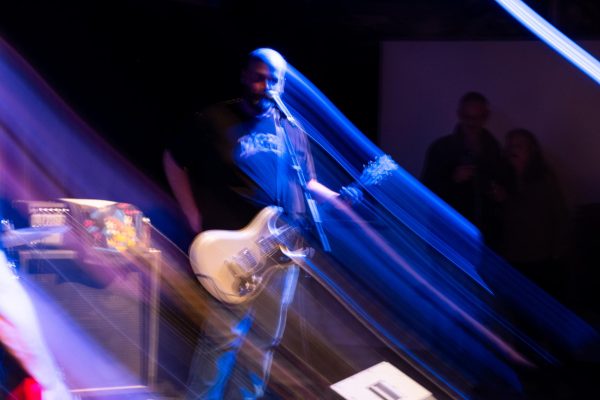
Following the screening of the performances, there was a live performance by The Karloffs. The band formed in Boone in 1996, with all three current members being from the area. Guitarist Kevin Freeman described the band as “not polished, posed or prefab,” making the band a perfect fit to play after a screening of “The Cramps and The Mutants: The Napa State Tapes.”