
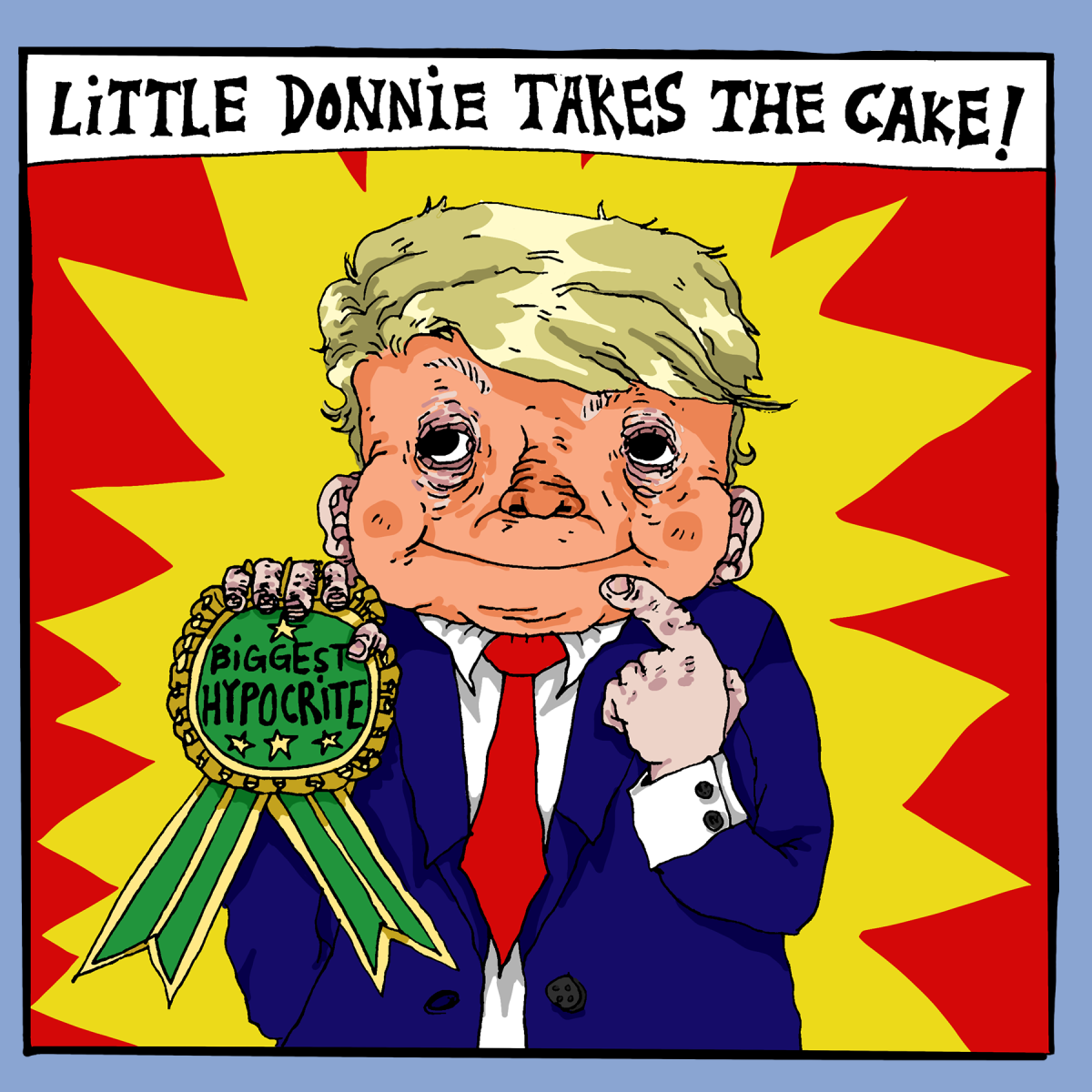
President Donald Trump must be a Marie Kondo fan because he’s decluttering his way through the United States Constitution. Whatever doesn’t “spark joy” is out the West Sitting Hall window, or out the gaping hole where the White House’s East Wing used to be.
Unsurprisingly, Trump’s recent attacks on fundamental freedoms have largely impacted specific identity groups, including immigrants, women and the LGBTQ+ community. However, the latest addition to his constitutional to-go list is a longcherished right of any U.S. resident: free speech.
The strength of an authoritarian leader inherently depends on their ability to suppress the spread of public information delivered by science, education and honest journalism. In true fascist fashion, Trump has employed sweeping policies of censorship at the forefront of his active campaign against free speech.
Considering this, it was not a surprise when, in July, Trump signed a bill rescinding $1.1 billion intended for the Corporation for Public Broadcasting — an invaluable resource that PBS, NPR and over 1,500 local public radio and television stations depend on to serve the public interest.
But this is just one example of the president using his bottomless pockets to get his way. Alarmingly, Trump has resorted to bribery to persuade top universities to adopt an alt-right agenda.
PBS News reported nine public and private schools across the country have been offered substantial financial incentives to undertake tasks such as adhering to the administration’s new definition of gender to bathroom policies and eliminating race and gender from admissions considerations. Some institutions have withstood the pressure to fall at Trump’s feet — others, like the University of Texas-Austin, seized the opportunity to expose their pitiful lack of a moral compass almost immediately.
Conversely, the Trump administration began slashing federal funding for universities accused of promoting liberal ideologies in the first half of the year according to the New York Times. While Harvard University notably fought back against this blatant attack on educational independence in court, a handful of other targeted institutions have since made deals with the White House to restore billions in much-needed grants.
By withholding and selectively distributing funds for institutions dedicated to educating and informing the public, the intentions of Trump and the leading orchestrators of his “Make America Great Again” movement are made crystal clear: to foster a country of malinformed, unquestionably loyal nationalists who won’t realize — or care — when their human rights are stripped away from them.
The nationalist portion of that ideal follower, while undoubtedly influenced by financial censorship, is the ultimate product of Trump’s more direct attacks on free speech.
Following the highly publicized assassination of conservative activist Charlie Kirk, online spaces were overtaken with reactionary content originating from both sides of the aisle. Many responded to the death with tears and prayers for the Kirk family, while others used the opportunity to highlight the hatred Kirk espoused during his life.
While many posts criticizing the Turning Point USA founder took the situation to an extreme with celebratory remarks, conservatives accelerated it into threatening territory. Within days after Kirk’s death, people began reporting job losses related to statements they had made about the assassination. These firings seemed to specifically target educators, with dozens of school districts and universities letting employees go. The South Carolina Daily Gazette reported three staff members were terminated from Clemson University alone.
These unorthodox firings have resulted in several lawsuits, two of which involve Auburn University, according to Birmingham news station WVTM. Such disputes have serious implications for the protection of free speech in legal proceedings, and while most have yet to settle, the executive branch seems to have already decided the matter. While guest-hosting the Charlie Kirk show, Vice President JD Vance told listeners outright to report those celebrating Kirk’s death online to their employers.
This intertwining of job security with political expression is a grave symptom of a dying democracy. A pattern is emerging in the U.S., and the Kirk firings are just a fraction of it.
In a similar case covered by the Daily Tar Heel, a professor at UNC-Chapel Hill was placed on administrative leave for prior association with a left-wing organization called Redneck Revolt. The university’s reasoning behind the temporary suspension cited “expressions of concern regarding alleged advocacy of politically motivated violence.”
Excluding threats and aggressive displays of discrimination, nobody should ever have to sacrifice their ability to make a living to express an opinion. Rampant surveillance measures have transformed the internet, a once vibrant medium of self-expression and inter-community engagement, into a digital minefield.
This isn’t to say that individuals shouldn’t be responsible for what they post online or that employers don’t have a right to choose who represents their businesses. The problem arises when sniveling MAGA minions assume the role of the White House’s flying monkeys, reporting any content that doesn’t align with their perspective to higher-ups in the hopes of engaging in a twisted retribution ritual.
This expanding state of conservative surveillance is driven by a prevailing theme of hypocrisy in the MAGA movement. Contradictions between the Trump administration’s words and actions are frequent and comically overt.
On Jan. 20, President Donald Trump signed an executive order entitled “Restoring Freedom of Speech and Ending Federal Censorship,” a shallow, self-congratulating gesture that should have served as an ironic wakeup call. If Trump truly planned on preserving free speech, he wouldn’t need to constantly assure people of such — he would do it.
When people are afraid to express their thoughts online for fear of losing their income or ending up on a right-wing doxxing list, is speech truly free? Not when the president and his entourage are encouraging such behavior, and especially not when spaces dedicated to the open exchange of ideas, like universities, become targets.
Interference in journalism, higher education and job security doesn’t even begin to describe the extent of censorship tactics and threats the U.S. government has undertaken to suppress free speech. The administration has turned to cleansing government websites and publishing the “Countering Domestic Terrorism and Organized Political Violence” presidential memoranda, declaring those who support “anti-Americanism, anticapitalism, and anti-Christianity” views as domestic terrorists. These are other disgusting ways through which Trump is narrowing access to public information and fostering a culture of unwavering Christian nationalism with fascist rhetoric.
As censorship offenses continue to mount and become more severe, more people will fall victim to the insidious phenomenon of desensitization, and the cycle will continue. This, however, doesn’t change the simple fact that you cannot cherry-pick what ideas are acceptable to have. People will persevere.
In a country where being an uneducated, self-obsessed xenophobe is accepted and encouraged in mainstream U.S. society, factual knowledge and independent expression are invaluable. Avoiding the ever-encroaching wave of authoritarian assimilation is more accessible than one might think. Read and donate to independent journalism sources. Advocate for the underprivileged and vulnerable. Create art. Build community — free speech is worth nothing without anyone to talk to.
Above all, let hope guide action. Trump wouldn’t be fighting so hard to suppress free speech if it weren’t the biggest threat to his power.
